End-to-End RNA-Seq Data Analysis With Python-Based Pipeline
About Course
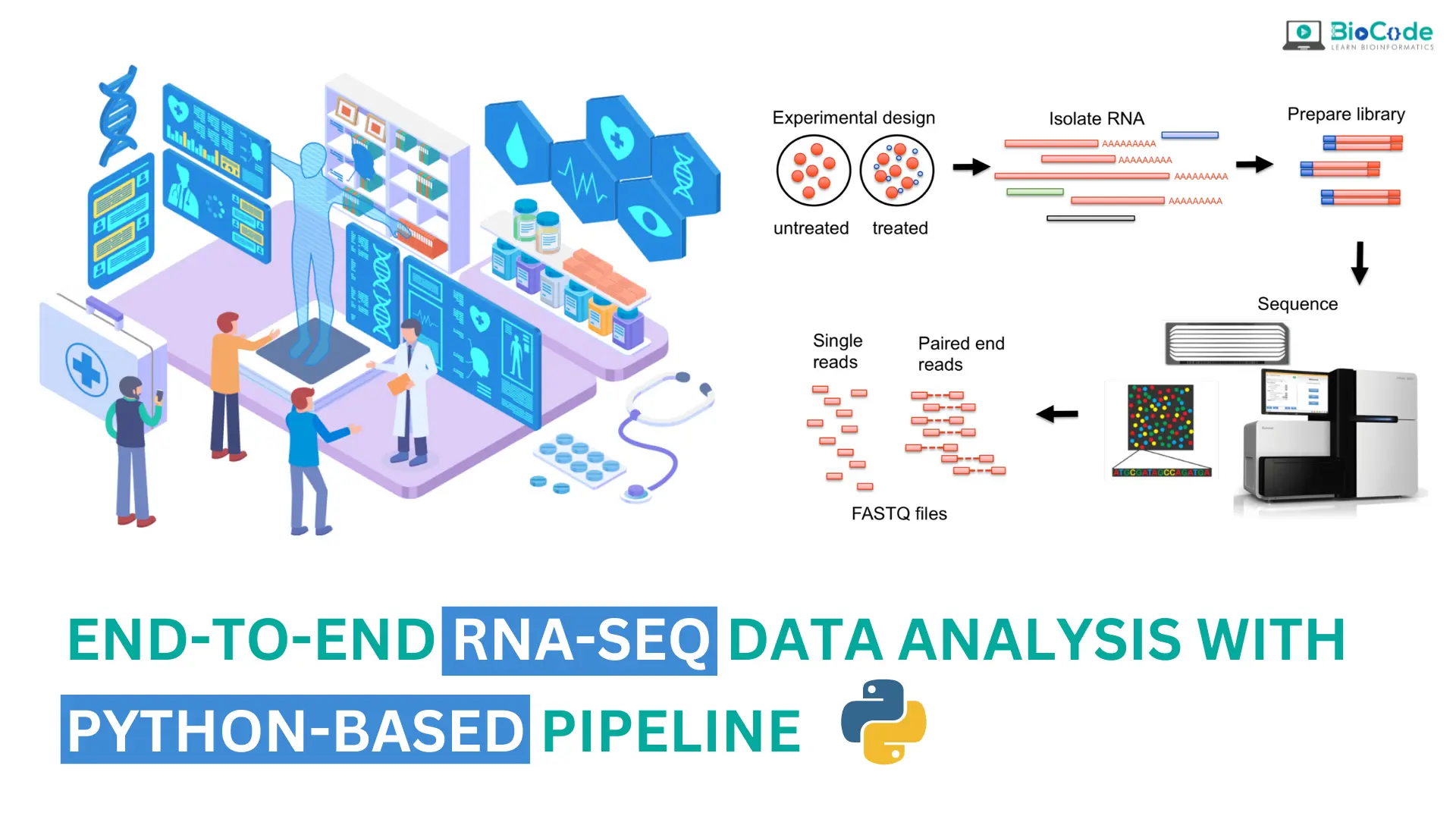
“End-to-End RNA-Seq Data Analysis With Python-Based Pipeline” is a comprehensive course designed to equip learners with the skills and knowledge necessary to conduct thorough RNA-Seq data analysis using a Python-based pipeline. From conceptual understanding to practical implementation, this course covers all facets of RNA-Seq data analysis, making it ideal for students, researchers, and professionals in bioinformatics, genomics, and computational biology.
The course begins with an exploration of fundamental concepts in RNA-Seq data analysis, including sequencing technology, quality control measures, and normalization techniques. Participants will then delve into the preprocessing of raw RNA-Seq data, mastering tasks such as quality assessment, adapter trimming, and read alignment to a reference genome.
Through engaging lectures and hands-on exercises, learners will gain proficiency in differential gene expression analysis using statistical models and data visualization tools. Additionally, participants will become adept in leveraging popular Python libraries for data analysis, including NumPy, Pandas, Matplotlib, and Seaborn.
Real-world RNA-Seq datasets will be utilized throughout the course, providing learners with practical experience and enabling them to apply their newfound skills to a comprehensive case study. Interactive exercises and quizzes will reinforce learning objectives and offer immediate feedback, ensuring a dynamic and effective learning experience.
By the conclusion of the course, participants will have constructed a robust pipeline for RNA-Seq data analysis using Python. They will possess the ability to perform quality control assessments, execute read alignments, conduct differential gene expression analyses, and produce publication-quality visualizations. Equipped with these skills, learners will be well-prepared to undertake RNA-Seq data analyses independently and pursue further studies in bioinformatics, genomics, and computational biology.
No prior programming experience is required to enroll in this course, although a familiarity with the Unix command line and basic statistical concepts is recommended. To get started, participants need only access to a computer with a recent version of Python and the requisite libraries installed.
Enroll today in “End-to-End RNA-Seq Data Analysis With Python-Based Pipeline” and embark on a journey towards mastering RNA-Seq data analysis using Python-based tools!
A complete RNA-Seq pipeline you build in Python
RNA-Seq is the most commonly requested analysis in genomics, and most researchers meet it as a black box — a core facility returns a spreadsheet of differentially expressed genes and the reasoning that produced it stays hidden. This course takes about 7 hours to make the whole pipeline explicit, built and run by you in Python.
What you work through
- RNA-Seq and NGS fundamentals — what the sequencer measures and what it does not, which determines what your results can support.
- Genomic databases — locating and retrieving raw public data to work with.
- File formats — FASTQ, SAM/BAM, GTF and count matrices, and how each stage transforms one into the next.
- Quality control and trimming — reading QC output and deciding what to remove.
- Mapping and alignment evaluation — aligning reads and judging whether the alignment is good enough to proceed.
- Differential expression — identifying genes that genuinely change between conditions.
- Functional analysis — Gene Ontology and KEGG pathway enrichment, turning a gene list into biology.
The part that decides the result
A differential expression list is only as good as the design behind it and the filtering in front of it. The course covers why replicates matter more than depth, what multiple testing correction is protecting you from, and how normalisation choices change which genes appear significant. These are the points reviewers question, and the reasons a gene list fails to replicate.
What you can do afterwards
Take raw RNA-Seq data — yours or public — through QC, alignment, quantification, differential expression and enrichment, in Python, producing figures and a result you can explain step by step.
We also run this analysis for research groups as an RNA-Seq analysis service.
Who it suits
Researchers who have RNA-Seq data and want to analyse it themselves, Python users adding genomics to their skill set, and anyone who has received a differential expression list and wants to understand how it was produced. A Linux and R version of this pipeline is also available.
Learning path
Become an RNA-Seq analyst
- 1 Command-line Based Practical RNA-Seq Data Analysis With Linux & R
- 2 End-to-End RNA-Seq Data Analysis With Python-Based Pipeline · you're here
- 3 Hands-on: Single-Cell RNA-Sequencing Data Analysis Using Command-Line and R [Complete Training]
- 4 Hands-on: Single-Cell RNA-Sequencing Data Analysis Using Python [Complete Training]
Not ready to enrol?
Get the free syllabus & course updates
We'll email you the full outline for this course plus a starter guide — no spam, unsubscribe anytime.
Tools & technologies you'll use
- Python
- R
- Linux
- Bash / CLI
- Pandas
- NumPy
Free preview — sample these lessons before you enrol
Course Content
In-Depth Introduction to RNA-Seq
-
44:08
-
Introduction to ArrayExpress
09:56
Genomic Databases for Raw Data
File Formats
RNA-Seq Data Analysis Pipeline (Theoretical & Practical)
Legacy Tutorials
Earn a certificate
Add this certificate to your resume to demonstrate your skills & increase your chances of getting noticed.
Student Ratings & Reviews
Who this course is for
- The target audience for this course are biologists, beginners in Bioinformatics with no or little experience in Python or RNA-Seq
- People who need to discover differential gene expressions in their dataset
- People who need to complete their RNA-Seq research
What you need to start
- No Prior Knowledge of Python Required
- No Prior Knowledge of RNA-Seq Required
Common questions
Do I need any prior experience for this course?
These are the prerequisites: No Prior Knowledge of Python Required; No Prior Knowledge of RNA-Seq Required.
How long does End-to-End RNA-Seq Data Analysis With Python-Based Pipeline take to complete?
The course contains roughly 7 hours of material across 5 sections. It is self-paced, so you can work through it as quickly or slowly as suits you.
How long do I have access after enrolling?
Access is lifetime. Once you enrol you keep the course and any future updates to it, with no recurring fee.
Do I get a certificate?
Yes — you receive a certificate of completion once you finish the course, which you can share on LinkedIn or include in a CV.
Is this course hands-on or theory only?
It is project-based. You work with real research datasets and run the analyses yourself rather than only watching them being explained.
![Hands-on: Single-Cell RNA-Sequencing Data Analysis Using Python [Complete Training]](https://www.biocode.org.uk/wp-content/uploads/2023/02/Course-Thumbnail-for-Hands-on-Single-Cell-RNA-Sequencing-Data-Analysis-Using-Python.webp)
![Hands-on: Single-Cell RNA-Sequencing Data Analysis Using Command-Line and R [Complete Training]](https://www.biocode.org.uk/wp-content/uploads/2023/02/Course-Thumbnail-for-Hands-on-Single-Cell-RNA-Sequencing-Data-Analysis-Using-Command-Line-and-R.webp)