Choose how you want to learn
Hands-on Practical RNA-Seq Data Analysis With Galaxy
Buy this course
One-time purchase of this standalone course.
Continue to course checkout →Included with All-Access Core
This course is part of All-Access Core, so a membership opens it along with the rest of the core library. Annual All Access includes it too.
Compare both plans →Already bought this course? Sign in to start learning.
Hands-on Practical RNA-Seq Data Analysis With Galaxy
About Course
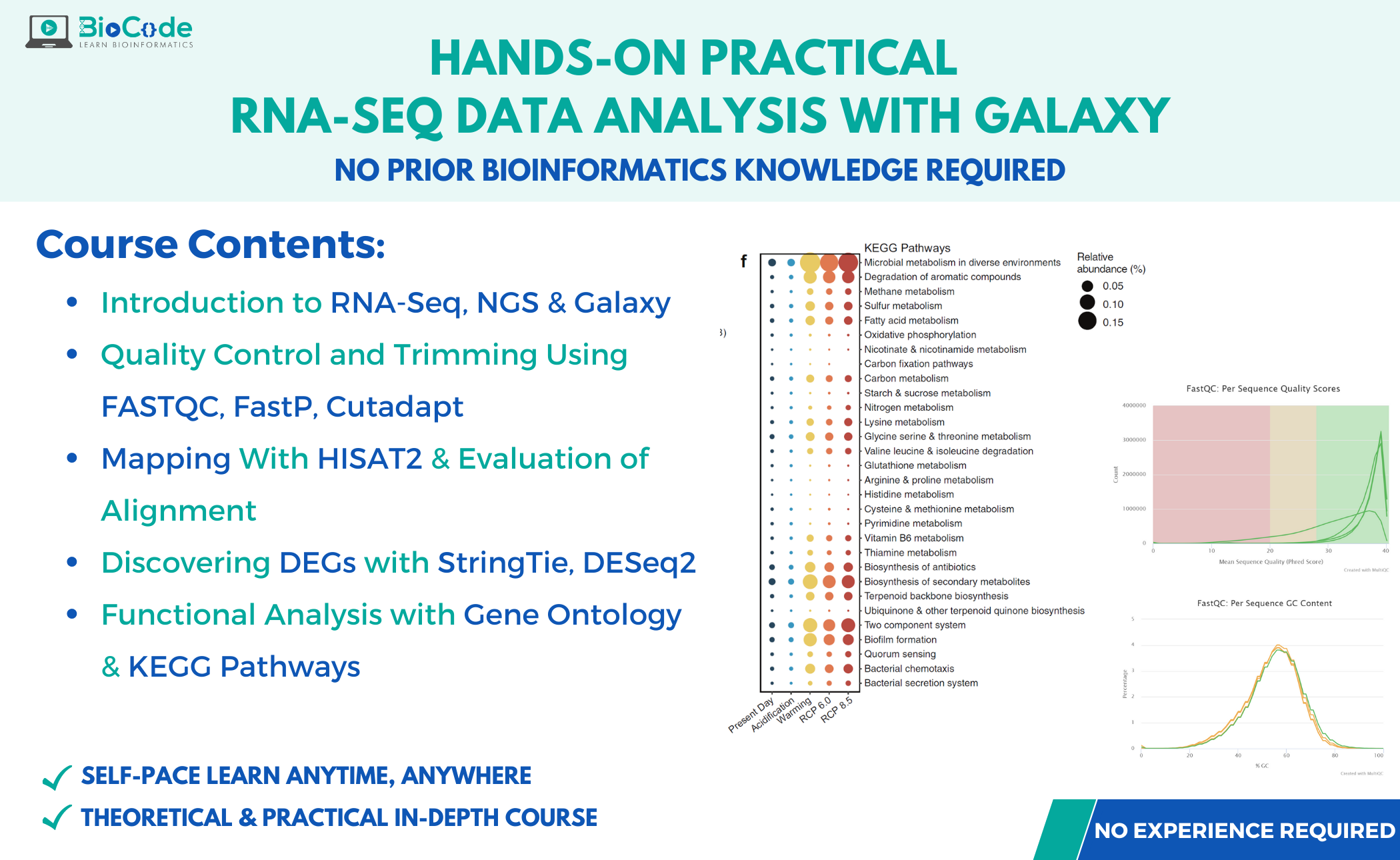
If you’ve ever been curious about understanding the inner workings of RNA-Seq and Next-Generation Sequencing (NGS) technologies, this comprehensive course is tailored specifically for you. Over the course of several engaging sessions, we will take you on a journey through the intricate process of analyzing genetic data.
Course Contents:
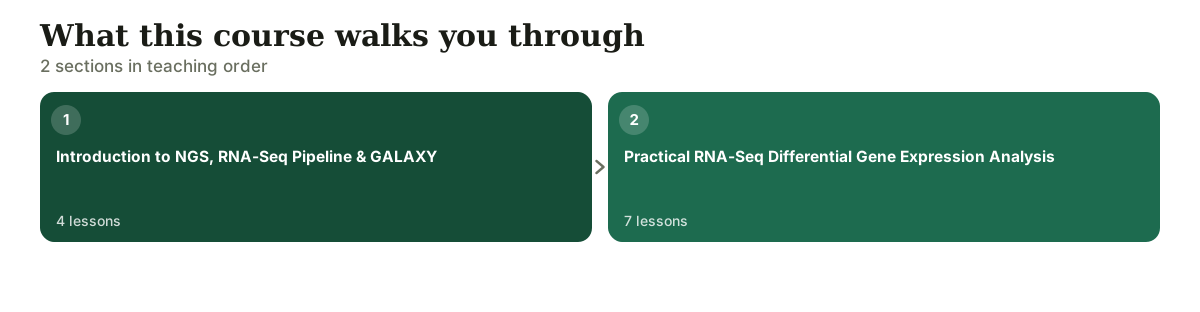
Introduction to NGS, RNA-Seq Pipeline & GALAXY
- Introduction to Next Generation Sequencing & RNA-Seq
- RNA-Seq Data Analysis Workflow
- What is Galaxy
- How to Get Started With Galaxy Account
Practical RNA-Seq Differential Gene Expression Analysis
- RNA-Seq Dataset Retrieval
- Quality Control with FastQC
- Pro-processing of the Reads
- Alignment of the Reads Against Reference Genome
- Post Alignment Processing
- Transcript Assembly and Quantification with StringTie
- Differential Gene Expression Analysis with DESEQ2
At the outset of this course, you will lay the foundation for your understanding the fundamental principles of RNA-Seq and NGS. You will grasp the core concepts that underlie this cutting-edge technology, ensuring that you have a solid grasp of the theory behind it.
As we progress, you will transition from theory to practice, gaining practical skills that are essential for working with genetic data. You will learn how to perform crucial Quality Control and Trimming tasks using popular tools like FASTQC, FastP, and Cutadapt. These steps are vital to ensure the reliability of your data before diving into deeper analysis.
Next, you’ll learn about mapping and alignment and using HISAT2 to align sequencing data to a reference genome, and you’ll also learn how to evaluate the efficiency of this alignment. This step is critical for accurately identifying the location of genetic sequences within the genome.
Finally, you’ll explore the world of functional analysis. You’ll use Gene Ontology and KEGG Pathways to interpret the biological significance of your findings, allowing you to extract valuable insights from your RNA-Seq data. This step is crucial for understanding the biological processes and pathways affected by the gene expression changes you’ve identified.
Don’t miss out on this unparalleled opportunity to enhance your bioinformatics skills and make a significant impact in the world of genomics. By the end of this course, you’ll be equipped with the knowledge and practical skills needed to confidently tackle complex RNA-Seq and NGS data analysis projects, making you a valuable asset in the ever-evolving field of genomics research. Join us on this exciting journey of discovery and empowerment!
RNA-Seq without writing code, using Galaxy
Galaxy is a web-based platform that runs standard bioinformatics tools through a browser interface. It exists precisely for researchers who need the analysis but not the command line, and it runs the same underlying tools a scripted pipeline would. This course covers a complete RNA-Seq differential expression analysis in Galaxy in about 3 hours.
What you work through
- RNA-Seq, NGS and Galaxy — how the sequencing works and how Galaxy organises an analysis into a reproducible history.
- Quality control and trimming — FastQC, fastp and Cutadapt, reading the reports and deciding what to trim.
- Mapping with HISAT2 — aligning reads to a reference genome and evaluating whether the alignment worked.
- Differential expression — StringTie and DESeq2 to identify genes that change between conditions.
- Functional analysis — Gene Ontology and KEGG pathway enrichment to interpret the result biologically.
Is Galaxy a compromise?
Not for this. The tools are the same ones a command-line pipeline calls — HISAT2 is HISAT2 whether launched from a terminal or a browser. What you trade is flexibility and scale: Galaxy is excellent for a standard analysis on a normal-sized dataset, and less suited to unusual workflows or very large cohorts where scripting wins. For a researcher who needs a clean, reproducible RNA-Seq result, it is a legitimate choice rather than a lesser one.
A useful side effect is that Galaxy records every step and parameter as a shareable history, which makes reproducing the analysis straightforward — something scripted pipelines often manage worse in practice.
What you can do afterwards
Run a complete RNA-Seq experiment from raw reads to an annotated, enriched gene list, entirely in a browser, and share the exact workflow with a collaborator or reviewer.
Who it suits
Wet-lab researchers with sequencing data and no programming background, students who need a result before they have time to learn Linux, and groups wanting a reproducible standard pipeline without maintaining one. If you later want the command-line route, our Linux and Python RNA-Seq courses cover the same analysis in code.
Not ready to enrol?
Get the free syllabus & course updates
We'll email you the full outline for this course plus a starter guide — no spam, unsubscribe anytime.
This course is part of All-Access Core, so $21.74 a month opens it along with the rest of the core library. See what that opens
Tools & technologies you'll use
- Python
- R
- Linux
- Bash / CLI
- Galaxy
- HISAT2
- DESeq2
- FastQC
Free preview — sample these lessons before you enrol
Course Content
Introduction to NGS, RNA-Seq Pipeline & GALAXY
-
12:09
-
RNA-Seq Data Analysis Workflow
01:20 -
What is Galaxy
04:11 -
How to Get Started With Galaxy Account
01:01
Practical RNA-Seq Differential Gene Expression Analysis
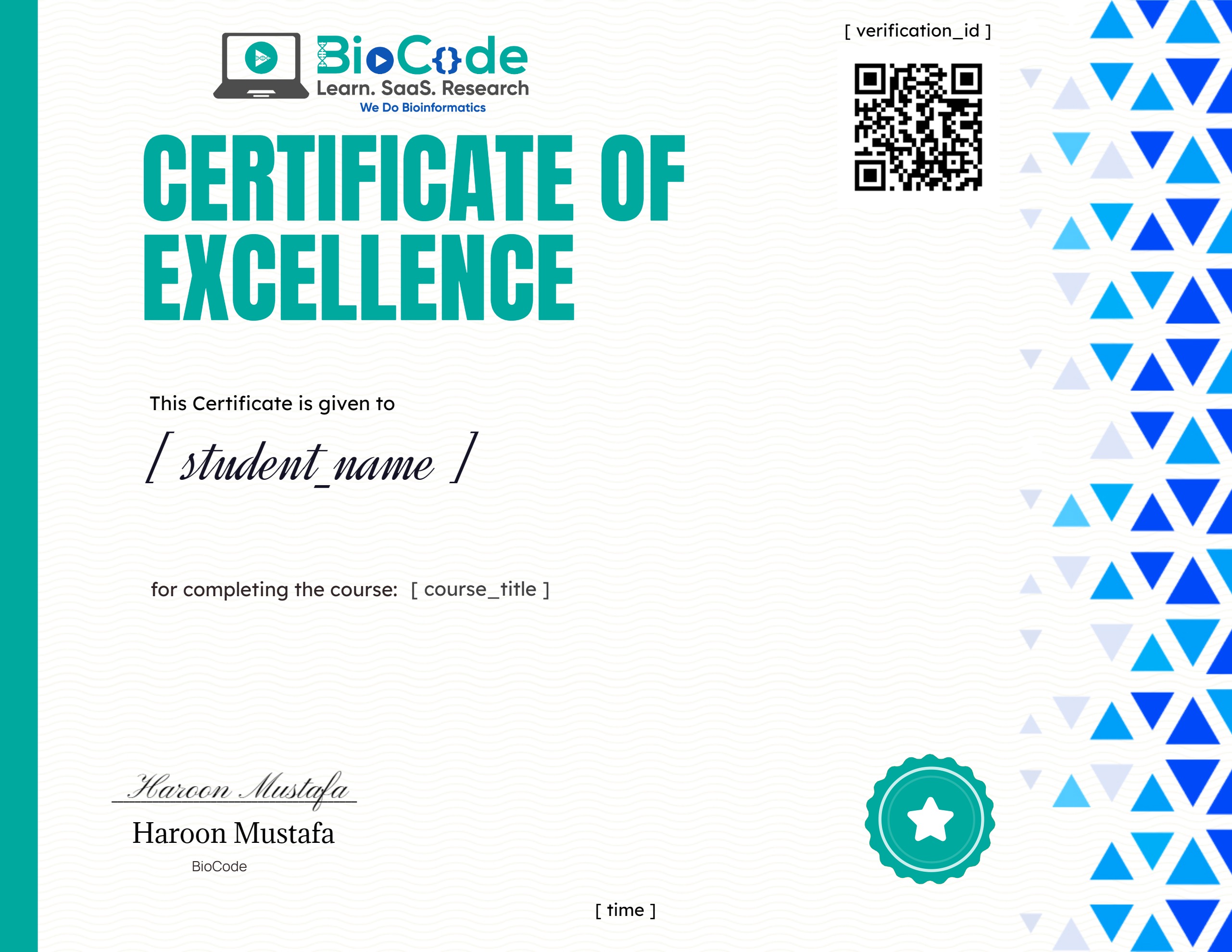
Earn a certificate
Add this certificate to your resume to demonstrate your skills & increase your chances of getting noticed.
Student Ratings & Reviews
Who this course is for
- Life Sciences students and researchers
- People working on differential gene expression
- People looking to implement RNA-seq in their research projects
- People who need to discover differential gene expressions in their dataset
What you need to start
- No prior Bioinformatics or programming knowledge.
- For beginners and advanced learners.
- Biology background required
- No Prior Knowledge of RNA-Seq Required
Common questions
Do I need any prior experience for this course?
These are the prerequisites: No prior Bioinformatics or programming knowledge.; For beginners and advanced learners.; Biology background required; No Prior Knowledge of RNA-Seq Required.
How long does Hands-on Practical RNA-Seq Data Analysis With Galaxy take to complete?
The course contains roughly 3 hours of material across 2 sections. It is self-paced, so you can work through it as quickly or slowly as suits you.
How long do I have access after enrolling?
Access is lifetime. Once you enrol you keep the course and any future updates to it, with no recurring fee.
Do I get a certificate?
Yes — you receive a certificate of completion once you finish the course, which you can share on LinkedIn or include in a CV.
Is this course hands-on or theory only?
It is project-based. You work with real research datasets and run the analyses yourself rather than only watching them being explained.
![Hands-on: Single-Cell RNA-Sequencing Data Analysis Using Command-Line and R [Complete Training]](https://www.biocode.org.uk/wp-content/uploads/2023/02/Course-Thumbnail-for-Hands-on-Single-Cell-RNA-Sequencing-Data-Analysis-Using-Command-Line-and-R.webp)
![Hands-on: Single-Cell RNA-Sequencing Data Analysis Using Python [Complete Training]](https://www.biocode.org.uk/wp-content/uploads/2023/02/Course-Thumbnail-for-Hands-on-Single-Cell-RNA-Sequencing-Data-Analysis-Using-Python.webp)