Introduction to Bioinformatics & Its Advancements
About Course
BioCode is providing a free course which carefully selects multiple videos from different courses so that you can assess the quality and learning experience from a diverse range of our courses. Once you have gone through the free course, you can then pursue a specific course to your liking. If you want the whole curriculum in a single subscription, consider All-Access Core: https://biocode.org.uk/membership-plans/ – if you are interested in a specific course, then visit: https://biocode.org.uk/courses
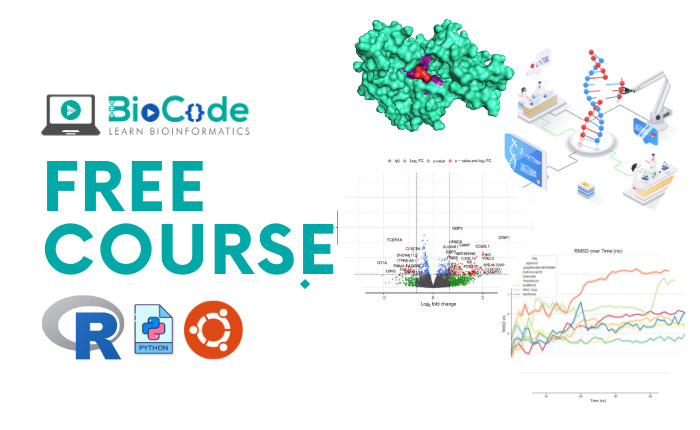
Explore the field of bioinformatics with our free course. It covers various topics and offers hands-on experiences. Through curated videos, gain insights into cancer biology, data analysis techniques, molecular modeling, variant calling, single-cell RNA sequencing, and more.
In the first section, “Introduction to Cancer Biology, Cancer Types, and Abnormal Cell Cycles,” understand the basics of cancer biology. Learn about different cancer types and how abnormal cell cycles contribute to cancer development.
Dive into data analysis with “In-depth Introduction to RNA-Seq Data Analysis.” Learn effective RNA-Seq data analysis by mapping preprocessed reads to a reference genome using popular tools like HISAT2, TOPHAT2, BOWTIE2, and STAR.
Build on this foundation with Next-Generation Sequencing (NGS) and variant calling. Explore variant calling techniques and the role of Single Nucleotide Polymorphisms (SNPs) in genetic variation.
Discover gene expression analysis, specifically single-cell RNA sequencing (RNA-seq). Uncover the power of studying individual cells and gain insights through filtering data, clustering cell subpopulations, and comparing bulk RNA-sequencing with single-cell RNA-sequencing.
Learn gene ontology analysis using GeneCodis4, a powerful tool for gene functional annotation. Analyze serum level differences between healthy individuals and patients using swarm plots, a visualization technique.
For structural bioinformatics enthusiasts, explore hydrogen bond interactions in 3D structures. Focus on an antibiotic-resistant fungal mutant protein and understand the importance of hydrogen bonds in molecular interactions.
Get insights into bioinformatics freelancing, including opportunities and challenges.
Finally, learn energy minimization techniques for protein structures in simulations. Enhance your understanding of molecular modeling and its applications.
By the end of this free course, you’ll have gained valuable knowledge and practical skills in bioinformatics. Whether you’re interested in cancer research, data analysis, structural biology, or freelancing, this course provides a strong foundation. Join us on this exciting journey into the world of bioinformatics!
The course is totally free and does not require any payment.
A free introduction to bioinformatics and where it is going
This free course is a genuine sample of how we teach. Rather than a trailer, it collects full lessons drawn from across our paid catalogue — roughly 3 hours 26 minutes of real material — so you can judge the pace, the depth and the teaching style before spending anything.
What you get from it
- An orientation to the field — what bioinformatics covers, how the major branches relate, and which skills sit underneath all of them.
- A sense of the tooling — where Linux, R and Python each fit, and why analysis work tends to need more than one.
- Lessons from several different courses — so you can see which area genuinely interests you before committing to a full training.
- Recent advances — how deep learning has changed structure prediction, and what single-cell methods made possible that bulk approaches could not.
Who it is for
Anyone considering bioinformatics and unsure where to start. Biologists who keep meeting analysis they cannot do themselves, students choosing a direction, and career changers working out whether this field suits them. No background in coding or statistics is assumed.
Where to go next
If the command-line lessons land well, the Linux and RNA-Seq courses are the natural continuation. If the structural material interests you more, molecular docking and molecular dynamics follow from it. If you would rather not learn the analysis at all, we also run it for research groups directly through our bioinformatics analysis services.
The course is free and stays free. There is no time limit on access and no card required to enrol.
Learning path
From zero to bioinformatician
- 1 Introduction to Bioinformatics & Its Advancements · you're here
- 2 Python for Bioinformatics: Fundamentals
- 3 Advanced Bioinformatics Scripting: Python, BioPython, R, BioConductor & Linux
- 4 Extensive Bioinformatician Course
Not ready to enrol?
Get the free syllabus & course updates
We'll email you the full outline for this course plus a starter guide — no spam, unsubscribe anytime.
Course Content
Free Course
-
Introduction To Cancer Biology, Cancer Types And Abnormal Cell Cycles
18:17 -
Loop Modeling – Fixing the Unmodelled Regions in Target Proteins
19:22 -
In-depth Introduction to RNA-Seq Data Analysis
44:08 -
Practical: Mapping Preprocessed Reads Against a Reference Genome Using HISAT2, TOPHAT2, BOWTIE2, STAR
31:51 -
In-depth Introduction to NGS and Variant Calling
20:12 -
Single Nucleotide Polymorphisms: An Introduction to SNPs and Their Types
31:22 -
Introduction to Single-Cell RNA-seq, Its Pipeline and Analysis
23:34 -
Bulk RNA-sequencing vs. Single-Cell RNA-sequencing
21:50 -
Hands-on: Filtering Dead Cell and Low Quality Data
22:39 -
Hands-on: Clustering of Cell Subpopulations
09:47 -
Hands-on: Gene Ontology Analysis Using GeneCodis4
14:21 -
Comparison of Serums Levels in Healthy and Patients Through Swarm Plots
08:34 -
How to Identify Hydrogen Bond Interactions in 3D Structures (Antibiotic Resistant Fungal Mutant Protein)
17:21 -
In-Depth Introduction to Bioinformatics Freelancing
31:44 -
Energy Minimization – Relaxing and Fixing the Structure for Simulation
11:25
Free previews from our paid courses
Earn a certificate
Add this certificate to your resume to demonstrate your skills & increase your chances of getting noticed.
Student Ratings & Reviews

Common questions
Do I need any prior experience for this course?
The course is taught from first principles, so you do not need previous experience with the specific tools it covers. A working understanding of molecular biology will help you get more from it.
How long does Introduction to Bioinformatics & Its Advancements take to complete?
The course contains roughly 3 hours 26 minutes of material across 2 sections. It is self-paced, so you can work through it as quickly or slowly as suits you.
How long do I have access after enrolling?
Access is lifetime. Once you enrol you keep the course and any future updates to it, with no recurring fee.
Do I get a certificate?
Yes — you receive a certificate of completion once you finish the course, which you can share on LinkedIn or include in a CV.
Is this course hands-on or theory only?
It is project-based. You work with real research datasets and run the analyses yourself rather than only watching them being explained.