Choose how you want to learn
Molecular Dynamics Simulation Course
Buy this course
One-time purchase of this standalone course.
Continue to course checkout →Included with Annual All Access
This course is part of Annual All Access, so one membership opens it and every other specialist course.
Compare both plans →Already bought this course? Sign in to start learning.
Molecular Dynamics Simulation Course
About Course
Molecular Dynamics Simulation Course Allows You To Develop The Advanced Level Skills In Analyzing MD Simulations
Molecular Dynamics is a computer simulation approach permitting the time evolution prediction of an interacting particular system which involves the generation of atomic trajectories of a system using numerical integration of Newton’s laws of motion to define specific interatomic potential using the initial condition and boundary condition.
It is one of the principle approaches for the study of biological molecules computationally for calculating the time dependent behavior of a molecular system. It provides detailed information about the fluctuations and conformational changes in proteins and nucleic acids.
MD simulation analysis is one of the essential steps while designing novel drugs using computational approaches. MD analysis not just evaluates and validates the protein structures, either predicted computationally or experimentally, but also validates the drug-target compatibility by providing various statistical information about the interacting drug-target complex.
In this course you’ll learn how to develop expertise in molecular dynamics simulations to predict the most suitable in silico conformations of biological macromolecules for drug designing & development and find the protein-protein interaction networks.
Joining and learning from the Molecular Dynamics Simulation Course can enhance your biological career by learning through various useful & informative pre-recorded lectures on Molecular Dynamics Simulation analysis using GROMACS.
Run your first molecular dynamics simulation, start to finish
Molecular dynamics predicts how a protein actually moves. Where a crystal structure gives you one averaged snapshot, an MD simulation computes the forces on every atom and steps the system forward in time, so you can watch a structure flex, a loop open, or a ligand settle into a pocket. This short, practical course takes you through that process once, properly, in GROMACS — the most widely used open-source MD engine in structural biology.
It is deliberately focused. In about 1 hour 20 minutes you go from a raw PDB structure to a completed, equilibrated simulation, without detours. The aim is that you finish able to run a simulation yourself rather than only understanding one in principle.
What the course covers
- Protein structure preparation — cleaning a downloaded PDB file, handling missing atoms, choosing a force field and generating topology.
- Solvation and system setup — placing the protein in a water box and neutralising the system with counter-ions.
- Energy minimisation — removing the steric clashes that would otherwise blow up the simulation on the first step, and reading the convergence output to know it worked.
- Visualising the minimised structure — confirming the system is sane before committing compute to it.
- NVT equilibration — bringing the system to the target temperature with the protein restrained.
- NPT equilibration — settling pressure and density so the box reaches a realistic state.
- Production simulation — launching the unrestrained run that produces the trajectory you analyse.
Why the equilibration steps matter
Most failed MD projects fail before the production run. A system that was never properly minimised, or that went straight to production without settling temperature and pressure, produces a trajectory that looks plausible and means nothing. The course spends its time on exactly these steps because they are where the result is decided — and because they are the steps most tutorials skip.
What you can do afterwards
You will be able to take a protein structure of your own, prepare it, and run a complete GROMACS simulation on a workstation or cluster. You will know what each configuration file controls, what the output of each stage should look like, and how to tell a system that has equilibrated from one that has not.
Analysing the resulting trajectory — RMSD, RMSF, radius of gyration, SASA and hydrogen bonding — is covered in our writing on how to analyse a molecular dynamics trajectory, and we run simulations for research groups directly through our molecular dynamics simulation services.
Who it suits
Structural biologists, computational chemists and bioinformatics students who need MD as a working tool. If you have a protein and a question about how it moves, this is the shortest route from that question to a running simulation. It assumes comfort with a command line but no previous MD experience.
Learning path
Structural bioinformatics
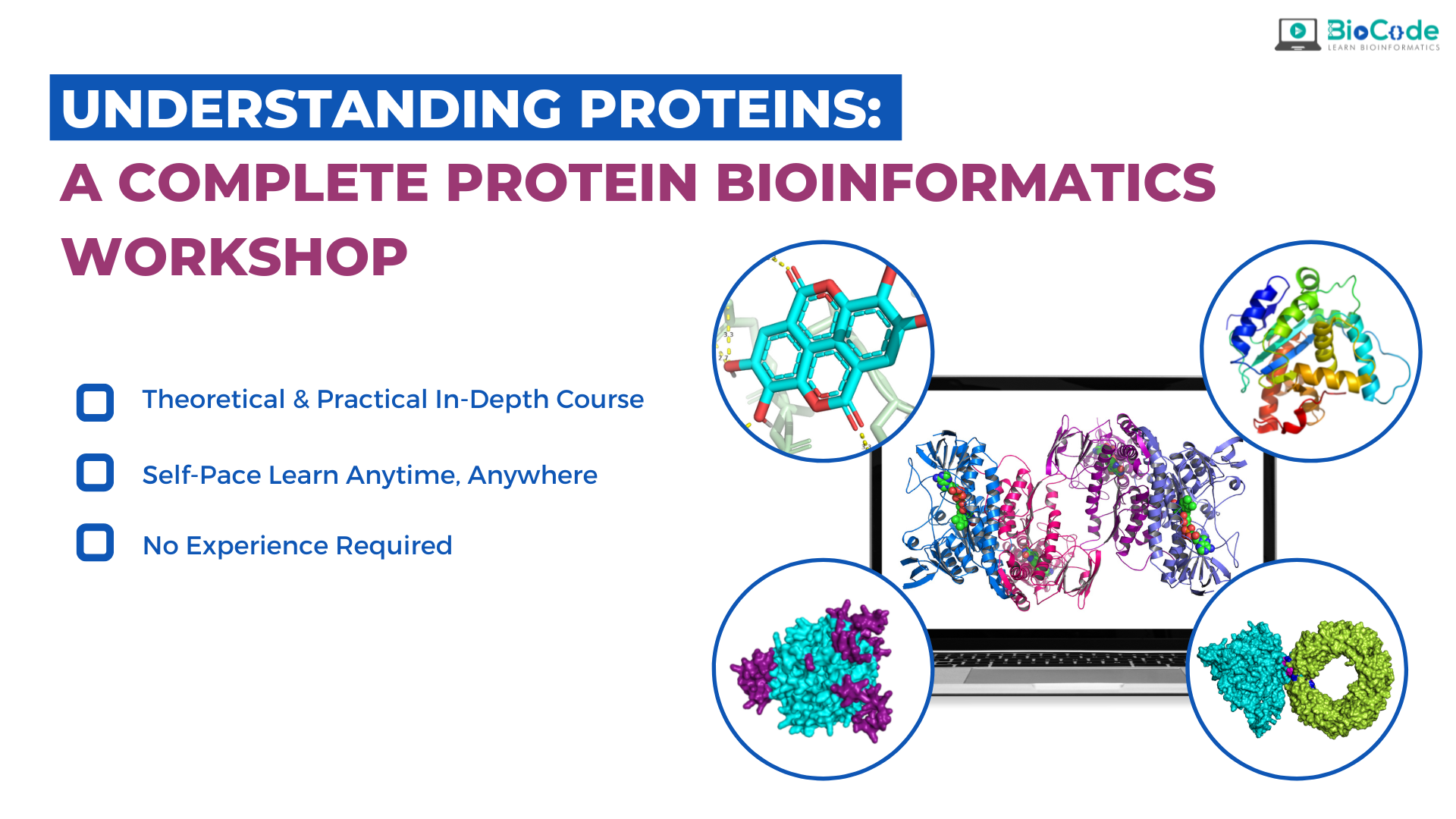
- 1 Understanding Proteins: A Complete Protein Bioinformatics Analysis Workshop
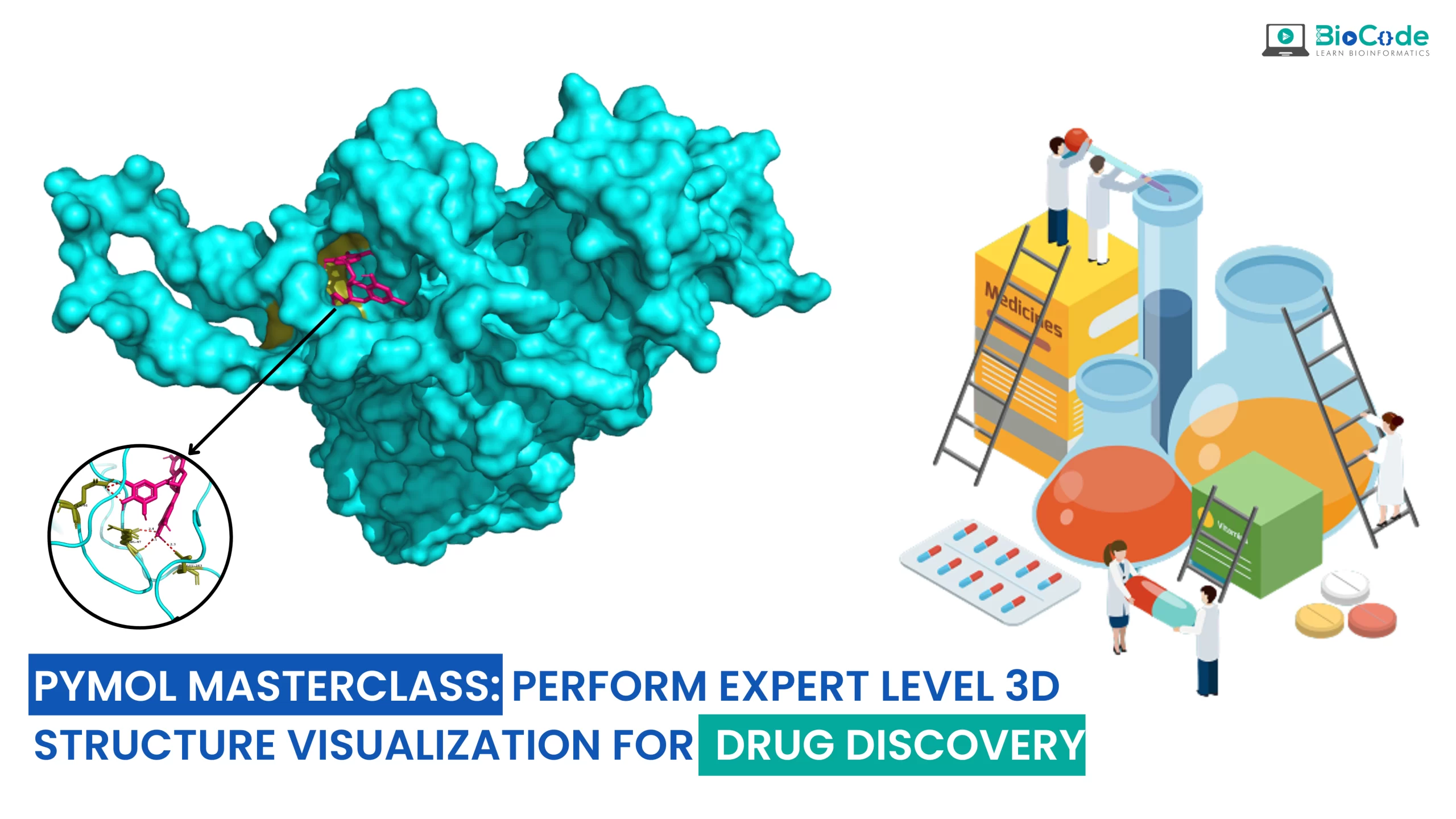
- 2 PyMol MasterClass: Perform Expert Level 3D Structure Visualization for Drug Discovery
- 3 Computational Drug Discovery and Design
- 4 Molecular Dynamics Simulation Course · you're here
Not ready to enrol?
Get the free syllabus & course updates
We'll email you the full outline for this course plus a starter guide — no spam, unsubscribe anytime.
This course is part of Annual All Access at $199.00 a year, which opens every specialist course as well. See what that opens
Tools & technologies you'll use
- Linux
- Bash / CLI
- GROMACS
Course Content
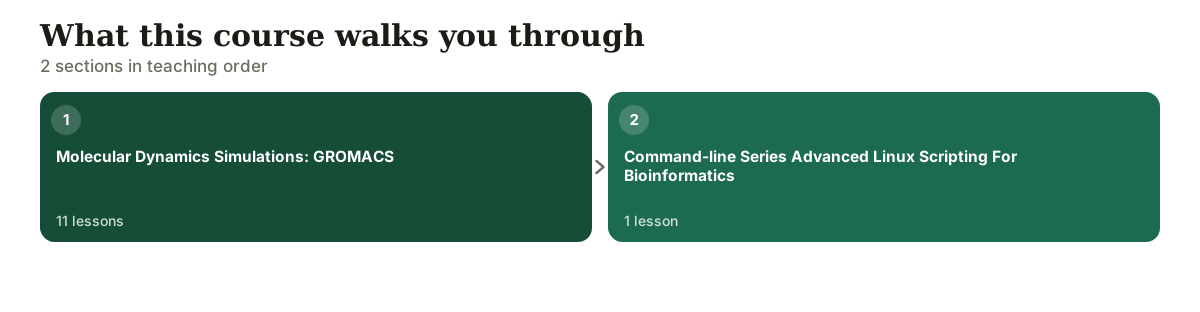
Molecular Dynamics Simulations: GROMACS
-
Getting Started With Molecular Dynamics Simulation – Pre-processing of Protein Structure and Removal of Unnecessary Structural Features
12:34 -
pdb2gmx – Construction of Topology File for Simulation
09:01 -
Defining a Solvant Box for Simulation
04:14 -
Solvation – Adding Water Molecules in Solvant Box
05:31 -
Generating Input Run File Replacement of Water Molecules With Ions
06:55 -
Genion – Replacement of Water Molecules With Ions
04:19 -
Energy Minimization – Relaxing and Fixing the Structure for Simulation
11:25 -
GRACE – Visualization and Analysis of Minimized Structure
04:12 -
Draft LessonEquibiliration of Protein Structure NVT ENSEMBLE Phase 1
08:38 -
Equibiliration of Protein Structure NPT ENSEMBLE Phase 2
08:10 -
mdrun – Executing Simulation Analysis
03:47
Command-line Series Advanced Linux Scripting For Bioinformatics
Earn a certificate
Add this certificate to your resume to demonstrate your skills & increase your chances of getting noticed.
Student Ratings & Reviews
Who this course is for
- The target audience for the Basic Linux Scripting For Bioinformatics are biologists, beginner or intermediate Bioinformaticians or data analysts with no or little experience in applications of computational bioinformatics and analysis.
- However, a superficial understanding of molecular biology and logic development for coding is expected from you before you join the course.
- Bioinformatics is quite easy to get started in, even if you lack a proper understanding of the underlying concepts of Bioinformatics databases, servers, tools and the algorithms working behind them.
Common questions
Do I need any prior experience for this course?
The course is taught from first principles, so you do not need previous experience with the specific tools it covers. A working understanding of molecular biology will help you get more from it.
How long does Molecular Dynamics Simulation Course take to complete?
The course contains roughly 1 hour 20 minutes of material across 2 sections. It is self-paced, so you can work through it as quickly or slowly as suits you.
How long do I have access after enrolling?
Access is lifetime. Once you enrol you keep the course and any future updates to it, with no recurring fee.
Do I get a certificate?
Yes — you receive a certificate of completion once you finish the course, which you can share on LinkedIn or include in a CV.
Is this course hands-on or theory only?
It is project-based. You work with real research datasets and run the analyses yourself rather than only watching them being explained.