Understanding Proteins: A Complete Protein Bioinformatics Analysis Workshop
About Course
It is important to analyze proteins to understand their biological importance and functions such as:
-
How two proteins interact with each other to perform their function(s).
-
What are their physiochemical properties, such as molecular weight, half-life and etc.
-
What are the important functional sites and regions of the proteins.
-
Which residues play the role in protein-protein interactions.
-
Which biologically important compounds have better binding affinity with the target protein.
-
What are the important domains present in the protein-of-interest and how these domains interact with other domains.
-
Which protein databases are available and what sort of protein data can be retrieved from them.
In this pre-recorded, pre-scheduled and pre-outlined Understanding Proteins – A Complete Workshop of Protein Bioinformatics Analysis. You’ll be learning a huge set of Bioinformatics skills that can help you with your Bioinformatics analysis and research, you’ll be learning and practicing Protein Bioinformatics skills through our pre-recorded workshop.
Everything you can learn about a protein, computationally
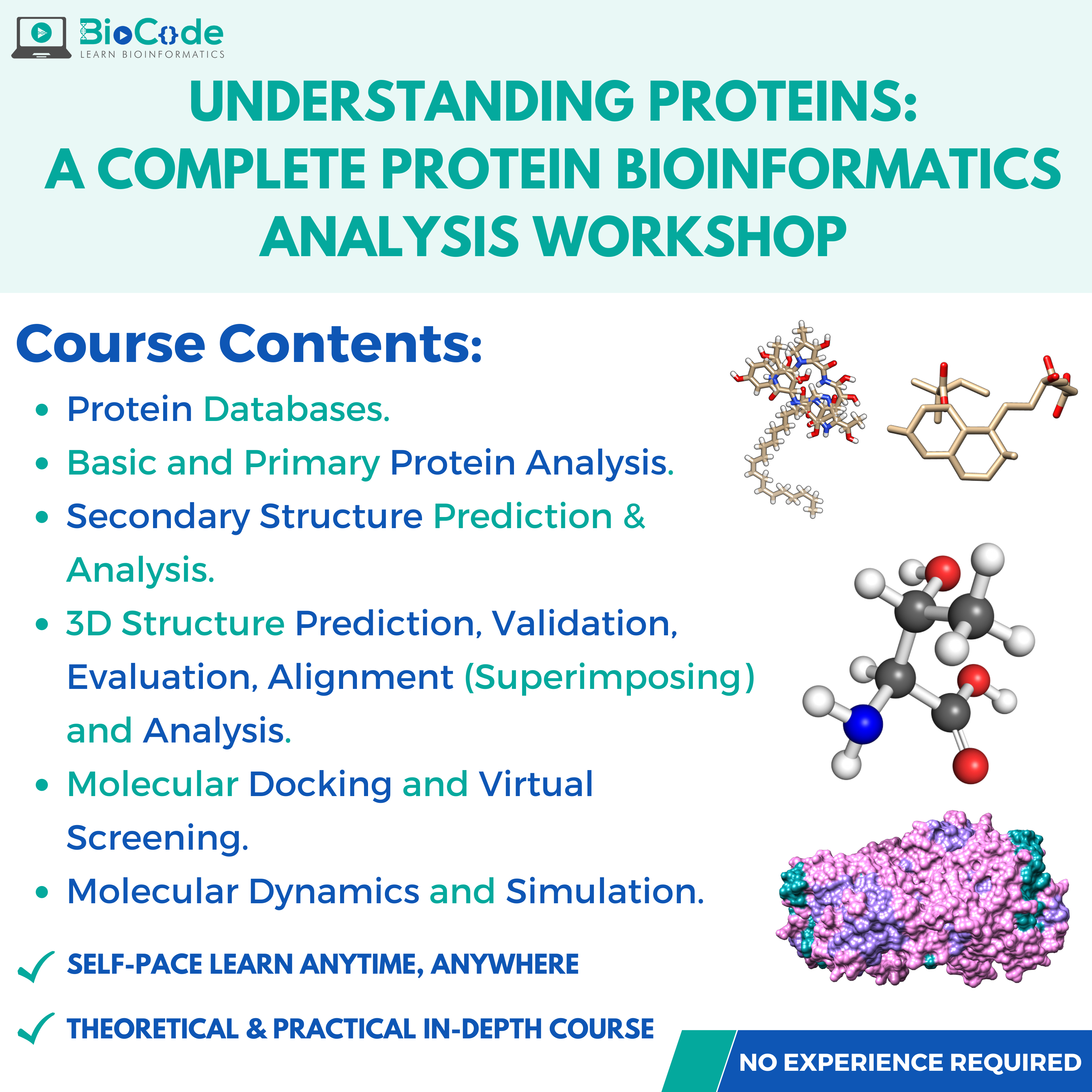
Given a protein sequence, computational methods can tell you a great deal before anyone touches a bench: its physicochemical properties, its likely fold, where its binding sites are, what it may interact with, and how stable that interaction is. This workshop covers that full path in six segments, each building on the last, so you finish able to characterise a protein end to end.
The six segments
- Protein databases — retrieving sequences and structures from UniProt and the PDB, and understanding what each record does and does not tell you.
- Sequence alignment and analysis — primary analysis, physicochemical properties such as molecular weight and isoelectric point, and comparing your protein against its relatives.
- Secondary and 3D structure prediction — predicting fold where no experimental structure exists.
- Structure visualisation and evaluation — producing figures, and validating a model with Ramachandran and quality scores before trusting it.
- Molecular docking and virtual screening — predicting how a ligand binds, and screening compound sets against your target.
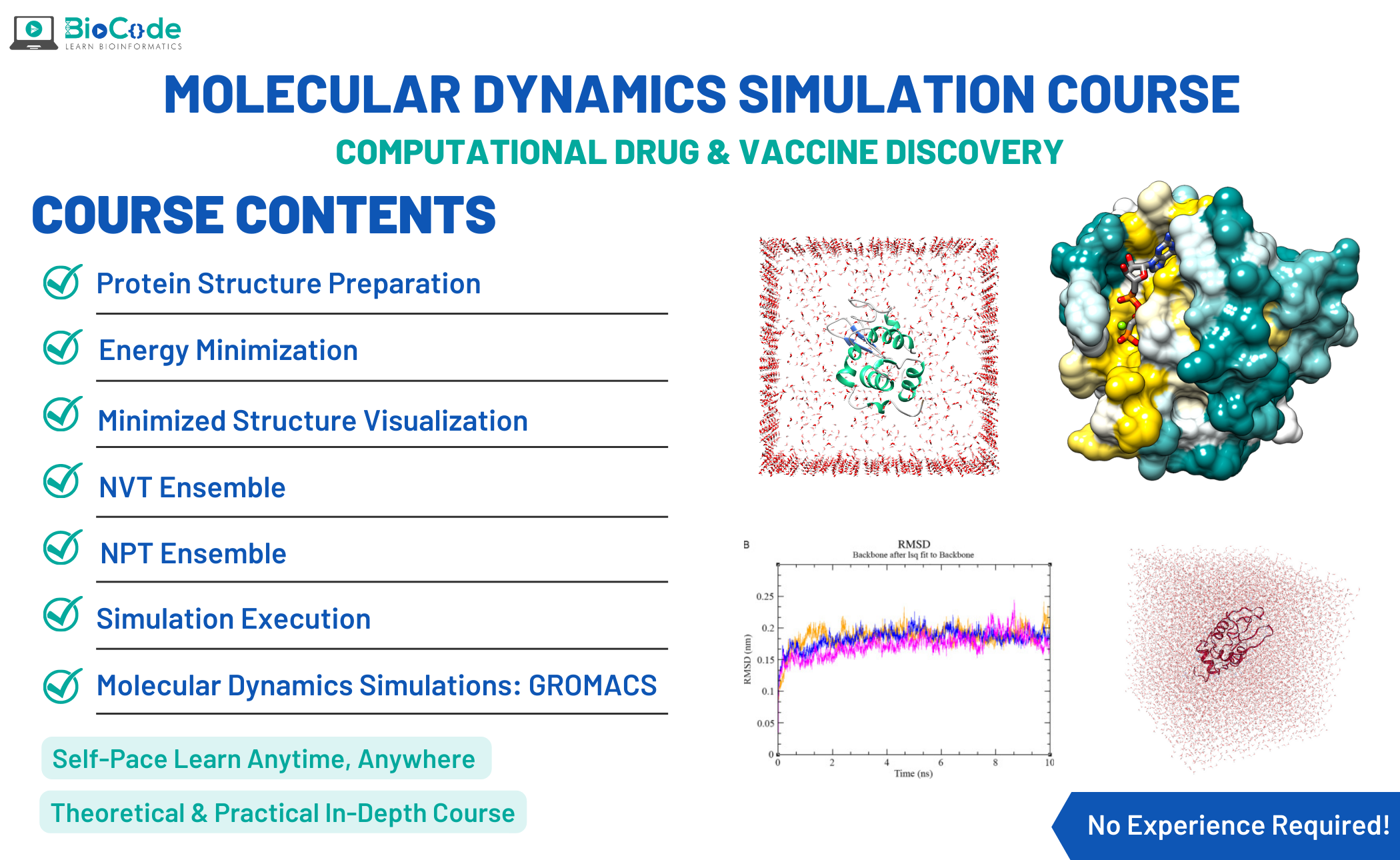
- Molecular dynamics — testing whether a predicted complex actually holds together in solvent.
Why the order matters
Each step depends on the quality of the one before it. Docking into a poorly validated homology model produces confident numbers about a structure that may be wrong; running dynamics on a bad docking pose wastes days of compute. The workshop is sequenced so that you learn to evaluate each output before building on it — which is the habit that separates usable structural work from a pipeline that merely runs.
What you can do afterwards
Take any protein of interest and produce a full computational characterisation: properties, predicted structure with validation, likely binding sites, docked complexes with candidate ligands, and simulation evidence for whether those complexes are stable. That is the standard package underpinning most structure-based drug discovery projects.
If you need this done rather than taught, see our molecular docking and molecular dynamics services.
Who it suits
Structural biologists, biochemists and drug discovery researchers who want the computational side of protein analysis in one place, and students who have used one or two of these tools in isolation and want to understand how they connect.
Learning path
Structural bioinformatics
- 1 Understanding Proteins: A Complete Protein Bioinformatics Analysis Workshop · you're here
- 2 PyMol MasterClass: Perform Expert Level 3D Structure Visualization for Drug Discovery
- 3 Computational Drug Discovery and Design
- 4 Molecular Dynamics Simulation Course
Not ready to enrol?
Get the free syllabus & course updates
We'll email you the full outline for this course plus a starter guide — no spam, unsubscribe anytime.
Tools & technologies you'll use
- Conda
Course Content
Segment 1: Bioinformatics Databases for Protein Analysis
-
Introduction to UniProt
09:56 -
UniProtKB & Protein Analysis
39:30 -
UniProteome & Retreieval of an Entire Proteome
13:05 -
UniRef & Retrieve Protein Clusters
11:36 -
UniParc & Find the Non-Redundant Entries
04:59 -
Peptide Search: Searching for a Particular Peptide on UniProt
03:15 -
Introduction to Protein Data Bank (PDB)
06:45 -
Accurately Searching for a Protein Structure on PDB & Protein Analysis
13:56 -
Browsing PDB According to Annotation
06:52 -
Digging Out Categorized & Specific Protein Structures from PDB Archives
06:23 -
3D Structure Visualization on PDB
10:49 -
Biological Annotation and Protein Features View & Analysis
08:18 -
Protein Symmetry: Understanding the Protein Validation
02:34 -
NCBI BLAST Database Searching
25:37 -
UniProt BLAST & Protein Database Searching
12:33 -
Introduction to InterPro
04:10 -
STRING: Protein-Protein Network Database and Analyzing PPI Between Proteins
13:17 -
Introduction to Molecular Modeling Database
08:07 -
InterPro – Protein Family Classifcation and Analysis
14:35 -
Protein & Protein Domain Analysis
09:29 -
Pfam: Understanding Protein Families and their Members
15:56 -
PROSITE: Understanding and Analyzing Protein Motif and Domain Profiles
13:46
Segment 2: Protein Sequence Alignment & Analysis
Segment 3: 3D Structure Prediction
Segment 4: 3D Structure Visualization & Evaluation
Segment 5: Molecular Docking and Docking Complex Evaluation
Segment 6: Molecular Dynamics & Simulation
Evaluation
Earn a certificate
Add this certificate to your resume to demonstrate your skills & increase your chances of getting noticed.
Student Ratings & Reviews
Who this course is for
- The target audience for this Understanding Proteins - A Complete Workshop of Protein Bioinformatics Analysis workshop are biologists, beginner or intermediate Bioinformaticians or data analysts with no or little experience in applications of computational bioinformatics and bioinformatics pipelines for protein analysis.
What you need to start
- However, a superficial understanding of molecular biology is expected from you before you join the workshop.
Common questions
Do I need any prior experience for this course?
These are the prerequisites: However, a superficial understanding of molecular biology is expected from you before you join the workshop..
How long do I have access after enrolling?
Access is lifetime. Once you enrol you keep the course and any future updates to it, with no recurring fee.
Do I get a certificate?
Yes — you receive a certificate of completion once you finish the course, which you can share on LinkedIn or include in a CV.
Is this course hands-on or theory only?
It is project-based. You work with real research datasets and run the analyses yourself rather than only watching them being explained.