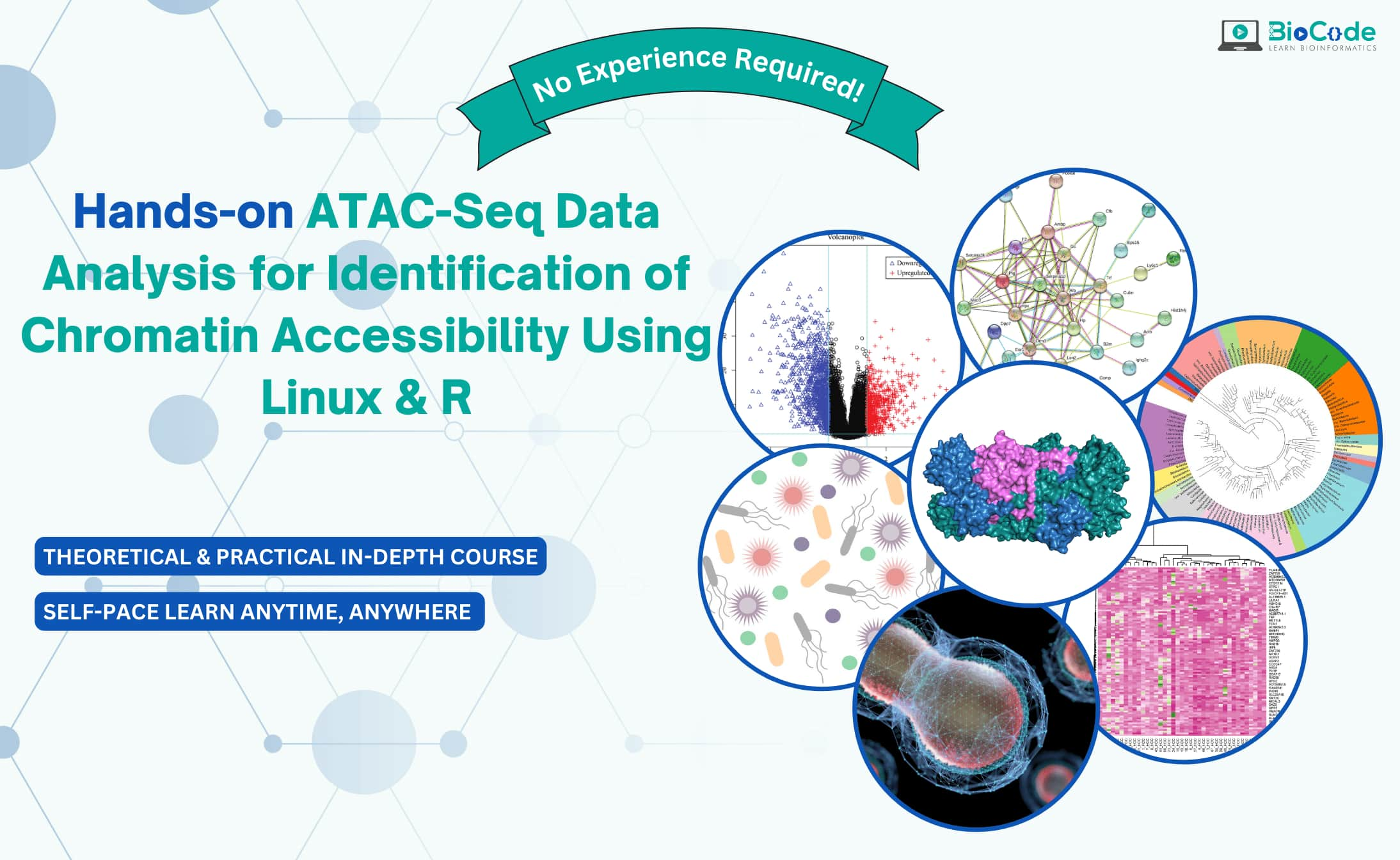
Hands-on ATAC-Seq Data Analysis for Identification of Chromatin Accessibility Using Linux & R
About Course
Map open chromatin with ATAC-Seq, in Linux and R
ATAC-Seq shows you which parts of the genome are accessible — where the regulatory machinery can physically reach the DNA. It needs very little input material and a short protocol, which is why it has become the standard method for profiling the regulatory landscape of a cell type or condition. This course covers the full analysis in Linux and R.
What you work through
- ATAC-Seq in depth — how Tn5 transposase tagging works, what accessibility does and does not tell you, and how ATAC-Seq relates to ChIP-Seq and DNase-Seq.
- Quality control — the three metrics that decide whether a library is usable: TSS enrichment, fragment-size periodicity and FRiP.
- Alignment and filtering — removing mitochondrial reads, duplicates and blacklist regions, each of which will distort your results if left in.
- Peak calling — identifying accessible regions and building a consensus set across replicates.
- Differential accessibility — finding regions that open or close between conditions.
- Motif and footprinting analysis — working out which transcription factors are driving the changes you found.
- Annotation — linking accessible regions to promoters, enhancers and nearby genes.
The quality control is not optional here
ATAC-Seq is unusually unforgiving. Slightly too much enzyme cuts through nucleosomal DNA and destroys the signal; degraded nuclei produce a library that sequences perfectly and means nothing. Both failures are invisible unless you look at the fragment-size distribution and TSS enrichment — so the course teaches you to read those before analysing anything. Our guide to ATAC-Seq quality control covers the same ground in writing.
What you can do afterwards
Take raw ATAC-Seq data through QC, alignment, filtering, peak calling, differential accessibility and motif analysis — and recognise a failed experiment before you spend a week analysing it.
We also run this analysis directly as an ATAC-Seq analysis service.
Who it suits
Researchers studying gene regulation, chromatin or development who have ATAC-Seq data, and bioinformaticians adding epigenomics to an existing RNA-Seq skill set. Linux and R are taught as part of the course.
Not ready to enrol?
Get the free syllabus & course updates
We'll email you the full outline for this course plus a starter guide — no spam, unsubscribe anytime.
Course Content
In-depth Introduction to ATAC-Seq Data Analysis
-
In-depth Introduction to ATAC-Seq Data Analysis and Its Biology (Chromatin Accessibility, Nucleosomes, Histones)
59:27 -
Selection and Retrieval of Raw ATAC-Seq Reads
20:55 -
What are Raw Reads & What is a FASTQ File
-
Introduction to Linux for ATAC-Seq Analysis
22:32
Hands-on ATAC-Seq Data Analysis
Additional Lectures
Earn a certificate
Add this certificate to your resume to demonstrate your skills & increase your chances of getting noticed.
Student Ratings & Reviews
Common questions
Do I need any prior experience for this course?
The course is taught from first principles, so you do not need previous experience with the specific tools it covers. A working understanding of molecular biology will help you get more from it.
How long do I have access after enrolling?
Access is lifetime. Once you enrol you keep the course and any future updates to it, with no recurring fee.
Do I get a certificate?
Yes — you receive a certificate of completion once you finish the course, which you can share on LinkedIn or include in a CV.
Is this course hands-on or theory only?
It is project-based. You work with real research datasets and run the analyses yourself rather than only watching them being explained.

