Functional Enrichment Analysis (Gene Ontology, KEGG Pathways Analysis, Protein-Protein Interaction) Using Webservers and R Scripting
About Course
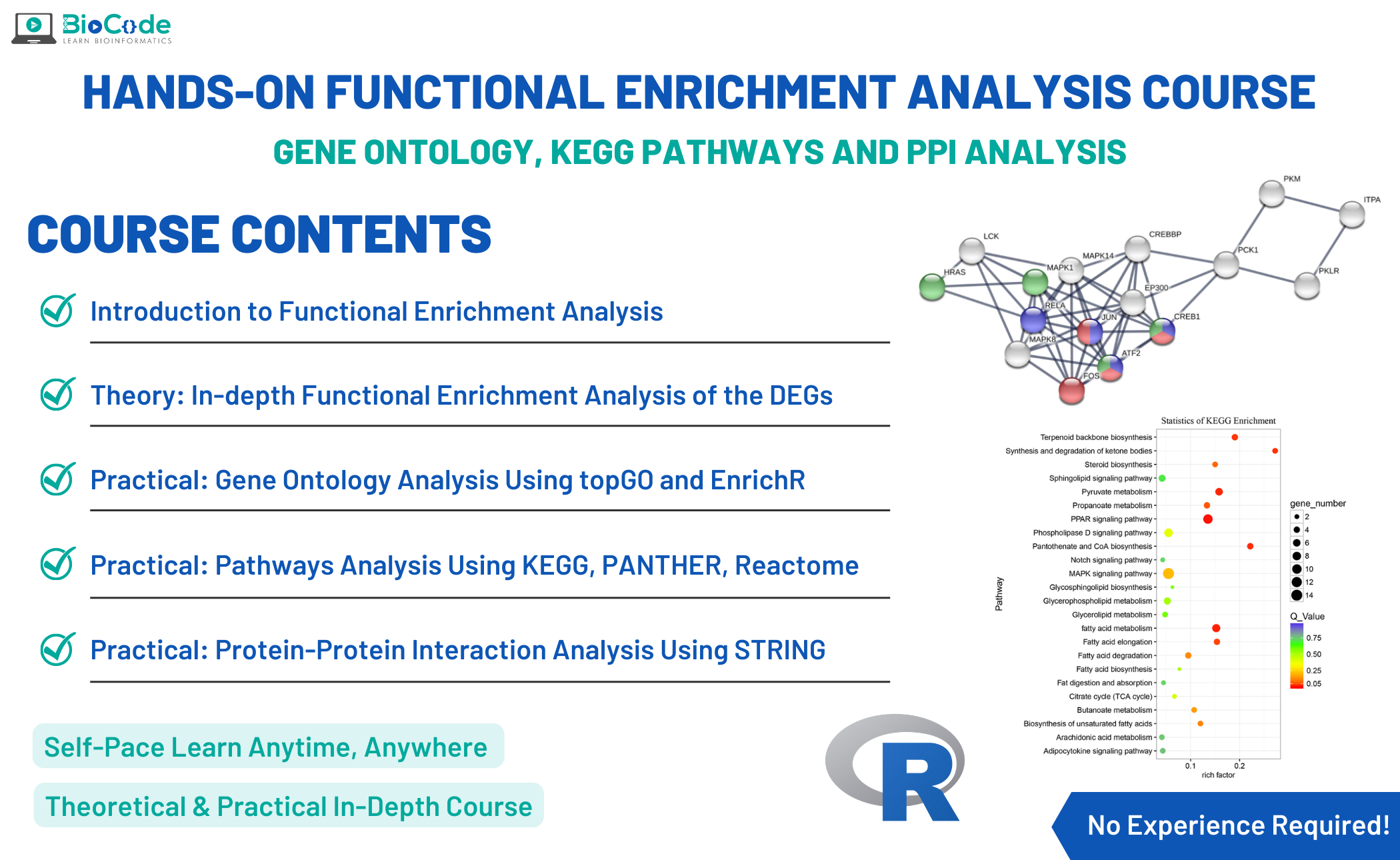
Section 1: In-depth Functional Enrichment Analysis of the DEGs (Theoretical)
Description: This section will focus on making sure that the students learn about the theoretical concepts of functional enrichment analysis and how it is done. Learning Outcomes: Upon completion of this section, students will be able to:- Understand What happens after DEG Analysis.
- Explain how we can interpret the Biomarkers further.
- Describe Functional Enrichment.
- Discuss the Tools for Functional Enrichment.
Section 2: Gene Ontology Analysis Using topGO and EnrichR (Practical)
Description: This section will focus on making sure that the students learn how gene ontology analysis is performed using EnrichR and topGo package. Learning Outcomes: Upon completion of this section, students will be able to:- Perform Biological Scripting in R Language.
- Perform Gene Ontology Analysis Using topGo in R.
- Perform Gene Ontology Analysis Using enrichR.
Section 3: Pathways Analysis Using KEGG, PANTHER, Reactome (Practical)
Description: This section will focus on making sure that the students learn about KEGG, PANTHER and Reactome and how the pathways analysis is performed using each server. Learning Outcomes: Upon completion of this section, students will be able to:- Perform KEGG pathways analysis.
- Perform PANTHER pathways analysis.
- Perform Reactome pathways analysis.
Section 4: Protein-Protein Interaction Analysis Using STRING (Practical)
Description: This section will focus on making sure that the students learn about protein-protein interaction analysis and how it is performed on the STRING database. Learning Outcomes: Upon completion of this section, students will be able to:- Explain Protein-Protein Interaction Analysis.
- Discuss STRING database.
- Perform Protein-Protein Interaction Analysis on STRING database.
Not ready to enrol?
Get the free syllabus & course updates
We'll email you the full outline for this course plus a starter guide — no spam, unsubscribe anytime.
Tools & technologies you'll use
- R
Course Content
Introduction to Functional Enrichment Analysis
-
Theory: Functinal Enrichment Analysis of the DEGs
18:39
Practical Approaches to Functional Enrichment Analysis
Earn a certificate
Add this certificate to your resume to demonstrate your skills & increase your chances of getting noticed.
Student Ratings & Reviews

Who this course is for
- The target audience for this course are biologists, beginners in Bioinformatics with no or little experience in R, Functional Enrichment Analysis or RNA-Seq
- People who need to discover differential gene expressions in their dataset
- People who need to complete their RNA-Seq research
- People who need to do downstream or Functional Enrichment Analysis of their DEGs list
What you need to start
- No Prior Knowledge of R or Functional Enrichment Analysis
- No Prior Knowledge of RNA-Seq Required
Common questions
Do I need any prior experience for this course?
These are the prerequisites: No Prior Knowledge of R or Functional Enrichment Analysis; No Prior Knowledge of RNA-Seq Required.
How long does Functional Enrichment Analysis (Gene Ontology, KEGG Pathways Analysis, Protein-Protein Interaction) Using Webservers and R Scripting take to complete?
The course contains roughly 1 hour 12 minutes of material across 2 sections. It is self-paced, so you can work through it as quickly or slowly as suits you.
How long do I have access after enrolling?
Access is lifetime. Once you enrol you keep the course and any future updates to it, with no recurring fee.
Do I get a certificate?
Yes — you receive a certificate of completion once you finish the course, which you can share on LinkedIn or include in a CV.
Is this course hands-on or theory only?
It is project-based. You work with real research datasets and run the analyses yourself rather than only watching them being explained.

